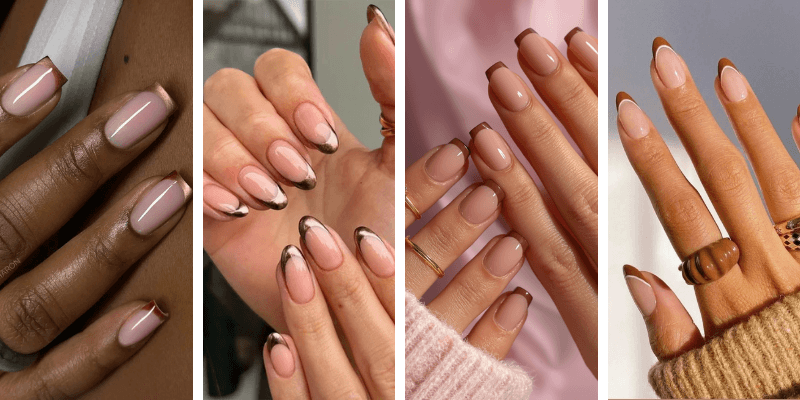
brown french tip nails hit that sweet spot between “put together” and “didn’t try too hard,” which is exactly the energy fall calls for. They work with gold jewelry, olive skin, pale skin, cool undertones, warm undertones — basically the whole spectrum, unlike some of the neon shades that only flatter a specific skin tone.
A lot of people assume the base and tip need to be the same tonal family, but the prettiest versions usually play with contrast. Think a warm nude or soft beige base with a dark brown tip, rather than brown-on-brown, which can read a little muddy on short nails especially.
Chocolate Brown French Tip Nails vs. Dark Brown
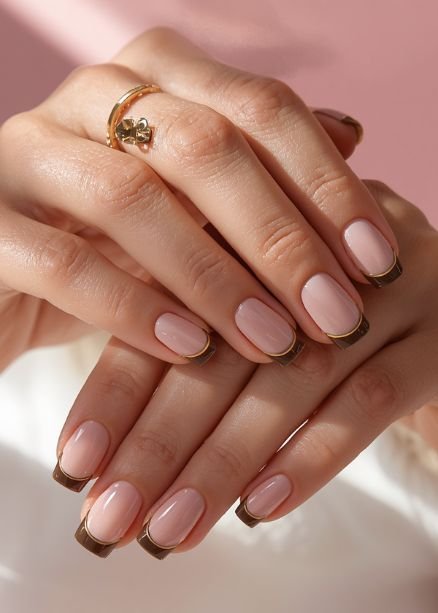
Chocolate brown leans warm — think melted chocolate, cinnamon undertones, sometimes even a slight reddish cast. Dark brown, on the other hand, can swing cooler, closer to espresso or almost-black, with less warmth pulling through.
Picking between them usually comes down to undertone. Chocolate brown tends to flatter warmer skin tones (think golden, olive, or those with yellow undertones), since the polish echoes similar warmth back at the skin. Dark brown looks sharper against cooler undertones — pink or blue undertones — because the coolness of the polish doesn’t fight with the skin’s natural tone.
Brown Fall Nail Inspo
A lot of dark brown polishes have gone the “jelly” route lately — a bit sheer, a bit glossy, letting some natural nail show through underneath. It’s a softer effect than the fully opaque chocolate shades, and it photographs a little differently under flash versus natural light, which is worth knowing if the nails are going to end up in a lot of photos this season.
One thing worth admitting: shade names on polish bottles are wildly inconsistent between brands. “Chocolate brown” from one brand can look nearly identical to another brand’s “espresso” or “cocoa.” Swatching in natural daylight before committing is really the only reliable way to know what’s actually going on the nail.
Brown French Tip Nails with Design: Ideas Worth Copying
For anyone wanting a bit more personality than a plain tip, there’s no shortage of options floating around right now. A few worth trying:
Brown and white polka dot french tips — playful without being juvenile, especially nice on shorter nails since the dots stay small and proportional.
Brown french tip nails with bow details on one finger — usually the ring finger — which keeps things from feeling overdone since only one nail is doing extra work.
Chrome brown french tips — a dusting of chrome powder buffed onto just the tip, rather than the whole nail, for shine without overkill.
A mistake that happens a lot with design nails: cramming too many elements onto one hand. Picking one accent detail — a gold line, a bow, a chrome finish — and letting the rest of the nails stay simple usually looks far more intentional than trying to combine three trends at once.
Brown Tortoise Shell French Tips
Tortoise shell nails have been building steam for a couple of years now, but the brown french tip version feels particularly suited to fall. The pattern usually combines two or three shades of brown with flecks of amber or black, painted or stamped in an irregular, marbled way that mimics real tortoiseshell material.
The technique isn’t as intimidating as it looks. Most nail artists apply a base color, then use a thin brush (or even a makeup sponge, dabbed lightly) to add irregular blotches in the darker shades before sealing with a glossy top coat. It’s forgiving because the whole point is imperfection — unlike a clean french line, there’s no single “wrong” way to place the pattern.
Tortoise shell nail art typically takes longer than a standard manicure, since it’s essentially hand-painted detail work on each nail rather than a single polish color. Budgeting extra time (and sometimes extra cost) for it is worth mentioning upfront.
Brown and White Polka Dot French Tips for a Playful Twist
Polka dots and french tips together sound like they shouldn’t work, but on short nails, the smaller scale actually makes the combination feel balanced rather than busy. A neutral or soft beige base, a brown tip, and then a few small white dots scattered along the tip or cuticle line is the most common version showing up lately.
Oversized dots on a short nail can look a bit weird, while tiny, evenly-spaced dots (usually made with a dotting tool, not a brush) read as more sophisticated. A dotting tool with a small 1mm to 1.5mm tip tends to give the cleanest, most proportional result on shorter nail beds.
A common misstep is spacing the dots too symmetrically, which paradoxically ends up looking less natural. A slightly irregular scatter — some dots closer together, a small gap elsewhere — tends to mimic the kind of organic pattern that reads as “designed” rather than “stenciled.”
Brown French Tip Nails with a Gold Line
This is one of the easier design upgrades to do without professional tools. A thin gold foil strip, gold striping tape, or even a fine detail brush with metallic polish, applied right along the smile line between the base color and the brown tip, adds a surprising amount of polish to an otherwise simple manicure.
The line should sit right at the boundary between the nude base and the brown tip — not floating above it or overlapping too far into either color — since that’s what gives it the clean, jewelry-like look rather than looking like a stray smudge.
For anyone doing this at home, gold striping tape is genuinely the easiest method. It’s applied before the top coat, pressed down firmly along the curve of the smile line, trimmed at the edges, then sealed over. No steady free-hand painting required, which makes it one of the more beginner-friendly design elements on this list.
Brown French Tip Nails with Bow Details
The single-accent-nail trend has stuck around for a reason: it lets people experiment with a bold detail without committing all ten fingers to it. Bows specifically have made a comeback across fashion more broadly this year, and it’s carried over into nail art too.
Usually this shows up as a small 3D bow charm or a hand-painted bow design placed on just the ring finger, while the rest of the hand keeps a clean brown french tip. The asymmetry is the whole point — it draws the eye without needing every nail to compete for attention.
If going the charm route rather than hand-painted, lightweight bow charms are important. Heavier embellishments on short nails can catch on things (clothing, hair, bag straps) more easily than people expect, so a flat or low-profile charm tends to hold up better day-to-day.
Pink and Brown French Tip Nails
Pink and brown together is a combination that’s grown a lot of fans recently, mostly because the pink keeps the whole look from skewing too autumnal or somber. It’s a nice middle-ground option for anyone who wants fall vibes but isn’t ready to commit to head-to-toe browns yet.
The most common version uses a soft dusty pink as the base with a brown tip, rather than the reverse. This ordering matters — a pink tip on a brown base tends to look more like a color-blocked accent nail than a cohesive french manicure, while a brown tip on pink reads as an intentional seasonal twist on the classic style.
Undertone coordination applies here too. Cooler-toned pinks (think mauve or dusty rose) pair more naturally with cooler dark browns, while warmer pinks (blush, peachy pink) sit better against chocolate or caramel-leaning browns.
All Brown Nails with One Brown French Tip
There’s a fun minimalist trend circulating where nine fingers get a solid brown polish and just one finger — usually the ring finger again — gets the classic tip detail. It’s subtle, it doesn’t require a steady hand for nine repeated french tips, and it still reads as intentional rather than plain.
This version works especially well for anyone newer to at-home nail art, since only one nail needs the more technical tip application. The other nine just need a clean, even coat of the solid brown, which is a much more forgiving task.
It also happens to be a great option for interviews, weddings, or other events where a full statement manicure might feel like too much — the solid brown reads polished and professional, while the single accent tip adds just enough personality to avoid looking plain.
Chrome Brown French Tip Nails for Extra Shine
Chrome nails have been a mainstay for a few years now, but applying the chrome pigment to just the tip — instead of the whole nail — is a newer, more wearable spin on it. A little chrome powder buffed onto the tip alone keeps the shine from feeling like too much for daytime wear, while still giving a noticeable metallic effect.
The application process: Chrome powder needs a completely tack-free, cured gel base underneath to adhere properly — applying it over regular polish or a still-tacky top coat is one of the most common reasons the chrome effect ends up patchy or dull instead of mirror-like.
A small, soft applicator (the kind that usually comes with chrome powder kits) works better than a brush for this. Rubbing the powder in with a gentle circular motion, rather than pressing it on in one spot, tends to give a more even, reflective finish across the whole tip.
Short Fall Nails 2026: What’s Trending Beyond Brown
Brown is clearly having its moment, but it’s part of a broader shift in nails 2026 toward shorter lengths and richer, more grounded color palettes overall. Deep greens, burgundy, and warm terracottas are showing up alongside brown as the go-to fall nail inspo short styles this season.
Shorter nails specifically seem to be trending for practical reasons as much as aesthetic ones — they’re easier to maintain, less prone to breaking, and honestly just more functional for day-to-day life, which matters more to people now than it maybe did a few years back when extra-long nails were everywhere.

Hi, I’m Maleesha, a fashion writer who focuses on practical outfit ideas for everyday wear. I share styling tips based on real-life scenarios, budgets, and comfort — not just trends.
Leave a Reply