
Dry skin and I go way back. And not in a good way. I’m talking about that tight, uncomfortable feeling right after washing your face — like your skin is two sizes too small. The flaky patches that show up uninvited right before something important. The way foundation just sits on dry spots instead of blending in. I’ve lived through all of that.
It wasn’t until I stripped everything back and learned the actual skin care basics that things started to shift. A proper routine, the right ingredients for dry skin specifically — and a few personal favorites like sweet almond oil — made more of a difference than any expensive product ever did.
That’s exactly what this post is about. Whether you’re starting completely from scratch or you’ve tried a dozen routines that never quite stuck — I’m going to walk you through everything I’ve learned. No fluff, no 47-step processes, no products that cost more than your grocery bill. Just the basics that actually work, especially if dry skin is your thing.
P.S: Sweet almond oil still gets its moment later in the post where it naturally belongs — in the evening routine section.
Why Skin Care Basics Matter More Than Any Single Product
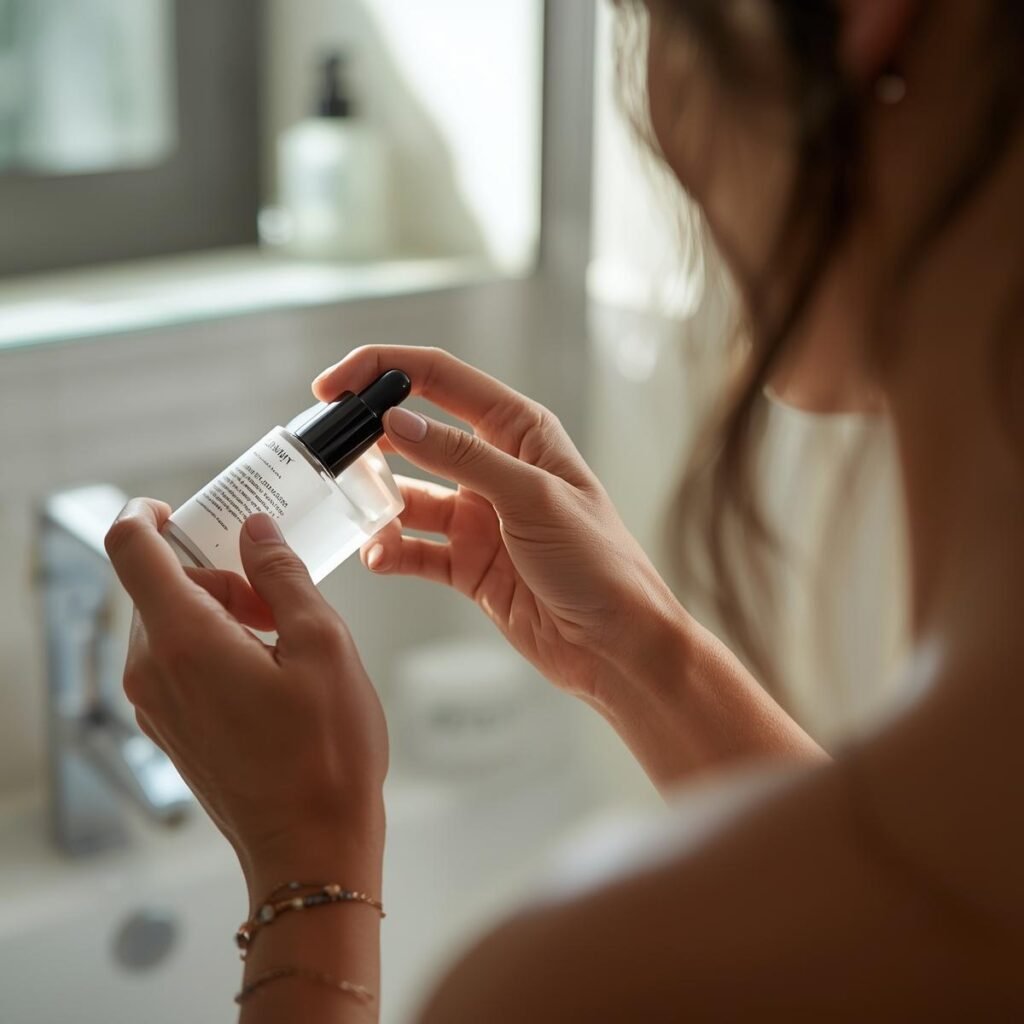
Your skin is the body’s largest organ, and it works hard every single day. It protects you from bacteria, pollution, UV damage, and environmental stress. When your routine is off — or nonexistent — your skin barrier weakens. For dry skin types, a compromised barrier means even more moisture loss, more sensitivity, and that relentless tight feeling that never seems to go away.
Mastering skin care basics for beginners doesn’t require a chemistry degree or a huge budget. It requires consistency, the right order of products, and understanding what your skin actually needs.
Step 1 — Confirm You Actually Have Dry Skin
This one tripped me up for years. Dry skin and dehydrated skin are not the same thing, and treating them the same way is a mistake that’ll keep you stuck.
Dry skin is a skin type — meaning your skin naturally produces less sebum (oil) than normal. It tends to feel tight, look dull, and show fine lines more easily. It’s genetic, largely, and it’s something you manage rather than cure.
Dehydrated skin is a condition — meaning your skin is lacking water, not oil. Even oily skin can be dehydrated. It’s usually caused by diet, weather, over-cleansing, or using the wrong products.
How to tell the difference?
Gently pinch a small area of your cheek. If it wrinkles easily and takes a moment to bounce back, your skin is likely dehydrated. If your skin constantly feels tight regardless of how much water you drink, you’re probably dealing with true dry skin.
Why does this matter? Because dry skin needs oil-based ingredients — think ceramides, fatty acids, and yes, sweet almond oil. Dehydrated skin needs water-based hydration first — think hyaluronic acid and glycerin. Getting this right is the foundation of any perfect skin care routine.
Step 2 — Build Your Basic Skincare Routine Around Dry Skin Needs
You do not need 15 products. A solid basic skincare routine for beginners with dry skin has four core steps: cleanse, hydrate, moisturize, and protect. That’s it.
Morning Routine for Dry Skin
Cleanser — In the mornings, dry skin often doesn’t even need a full cleanse. A simple rinse with lukewarm water is enough for a lot of people. If you do cleanse, use a creamy, hydrating formula. CeraVe Hydrating Cleanser is around $12 and is genuinely one of the best options for dry skin — it cleans without stripping. Avoid anything foaming or gel-based in the mornings, those tend to pull moisture right out.
Hydrating Serum — Apply a hyaluronic acid serum to slightly damp skin. This is important — hyaluronic acid draws moisture from the environment into your skin, but it needs a little water present to do that effectively. The Neutrogena Hydro Boost Serum runs about $20 and works well for this step.
Moisturizer — Don’t skip this even if your serum feels hydrating enough. For dry skin, you need something with ceramides and fatty acids to seal everything in. CeraVe Moisturizing Cream (the one in the tub, not the pump) is a dry skin staple for good reason. It’s thick, rich, and costs around $16.
Sunscreen — Up to 80% of visible skin aging is caused by UV exposure, and dry skin already shows fine lines more easily. That combination means SPF is genuinely non-negotiable. Use at least SPF 30 daily. EltaMD UV Clear SPF 46 is around $39 and sits beautifully under makeup without emphasizing dry patches.
Evening Routine for Dry Skin
Double Cleanse — At night, start with a cleansing balm or oil cleanser to remove sunscreen and any buildup. This first step is especially great for dry skin because oil-based cleansers are inherently more gentle and nourishing. Follow with your regular hydrating cleanser.
Treatment Step — If you want to add an active ingredient, keep it gentle. Bakuchiol is a plant-based alternative to retinol that delivers similar results — smoother texture, more even tone — without the dryness and irritation that retinol can cause, which dry skin really doesn’t need. The Inkey List Bakuchiol Moisturizer is about $15 and pulls double duty as a treatment and moisturizer.
Rich Night Moisturizer — Go heavier here than you do in the mornings. Your skin does most of its repair work overnight, and a richer moisturizer gives it the building blocks it needs. Look for shea butter, squalane, or ceramides on the ingredient list.
Sweet Almond Oil — This is my last step every single night. Two to three drops of sweet almond oil, warmed between my palms, pressed gently into my skin. It seals in everything underneath it and my skin wakes up noticeably softer the next morning. It’s rich in oleic acid, which mimics the skin’s natural sebum — making it particularly well-suited for dry skin types. A good cold-pressed bottle runs about $8–$10 and lasts for months.
Step 3 — The Affordable Skin Care Routine for Dry Skin
Dry skin does not require luxury products. Some of the most effective ingredients for dry skin — ceramides, glycerin, shea butter — are found in drugstore products that cost less than $20. Here’s a full affordable skin care routine built specifically around dry skin:
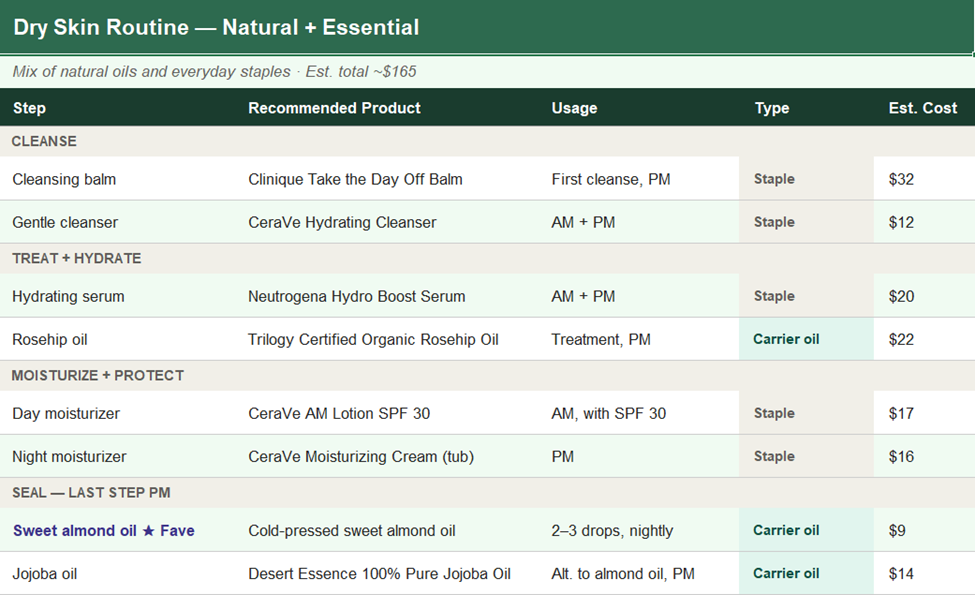
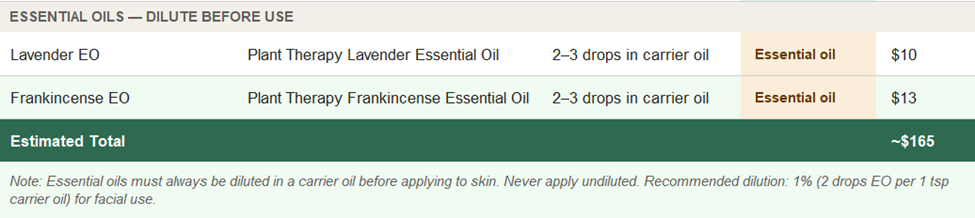
That’s a complete daily skin care routine for glowing skin for around $106 — and most of these products last two to three months easily.
Step 4 — Teen Skincare Routine Tips for Dry Skin
If you’re a teenager with dry skin, first — you’re not alone, and it does get more manageable. The mistake most dry-skinned teens make is assuming their skin is oily because it looks dull or feels rough, and then using products that strip it even further.
A simple teen skincare routine for dry skin looks like this:
1. Creamy cleanser morning and night
2. Light moisturizer in the morning
3. SPF 30 daily — this habit will pay off for decades
4. Richer moisturizer at night
If you’re dealing with teenage breakouts on top of dry skin — which is more common than people think — resist the urge to use harsh acne washes. They’ll just make the dryness worse. A gentle 2.5% benzoyl peroxide spot treatment applied only to active breakouts is a much smarter approach.
Step 5 — Glowing Skin Starts With the Same Basics

The face gets all the attention, but dry skin affects the whole body. Rough elbows, tight legs after a shower, ashy knees — all of it comes down to the same principle: your skin barrier needs support.
Exfoliate your body once a week with a gentle scrub — nothing too abrasive. Then moisturize within two minutes of stepping out of the shower, while your skin is still slightly damp. That two-minute window makes a real difference in how well your moisturizer absorbs.
For glowing body skin, look for body lotions with shea butter, glycerin, or urea. Urea is especially good for very dry patches on heels and elbows — it’s a keratolytic, meaning it gently breaks down rough, thickened skin. Gold Bond Healing Lotion runs under $10 and works as well as products costing three times as much.
Sweet almond oil works beautifully on the body too, by the way. Mix a few drops into your regular body lotion for an extra boost of nourishment, especially in winter.
Step 6 — DIY Skin Care Routine Add-Ons Safe for Dry Skin
Most DIY skincare advice on the internet is aimed at oily skin — clay masks, apple cider vinegar toners, the works. A lot of that stuff would absolutely wreck dry skin. So here are the DIY options that are actually safe and helpful:
Honey mask — Raw honey is a natural humectant, meaning it draws moisture into the skin. Apply a thin layer for 10–15 minutes, rinse with lukewarm water. It’s gentle, hydrating, and won’t disrupt your skin barrier.
Oat and sweet almond oil mask — Mix one tablespoon of finely ground oats with a few drops of sweet almond oil and enough warm water to make a paste. Apply for 10 minutes. The oats soothe irritation while the almond oil replenishes moisture. This one is genuinely worth trying.
Green tea toner — Brew a strong green tea, cool it completely in the fridge, and apply with a cotton pad after cleansing. It’s full of antioxidants, helps calm redness, and works as a gentle hydrating prep step before your serum. Not a replacement for a proper toner, but a nice affordable addition.
That’s where I’d stop with DIY for dry skin. The skin barrier is already working overtime — it doesn’t need lemon juice or baking soda anywhere near it.
What I Did Wrong With My Dry Skin
Over-exfoliating. I thought my dry, dull skin needed more scrubbing. It didn’t. It needed more moisture. Exfoliating more than once or twice a week with dry skin strips away what little natural oil you have and leaves your barrier even more compromised.
Using hot water. Long hot showers feel amazing, especially in winter. But hot water breaks down the lipid barrier in dry skin faster than almost anything else. Lukewarm water only — for both face and body.
Applying oil to dry skin. For a while I was applying sweet almond oil directly to completely dry skin and wondering why it just sat on top. Oils work best when applied over a damp moisturizer — they seal in hydration rather than replace it. Layer correctly and the difference is noticeable.
Changing products too fast. Skincare takes time. Most products need 6–8 weeks of consistent use before results show up. I used to give something two weeks, see no miracles, and move on. Patience is genuinely part of the routine.
Simple Skincare Routine — Quick Recap
Morning: Rinse or gentle cleanse → Hyaluronic acid serum → Moisturizer with SPF
Evening: Oil cleanse → Gentle cleanse → Treatment (optional) → Rich moisturizer → Sweet almond oil
Weekly: Gentle exfoliation once or twice, body moisturize after every shower
Always: Lukewarm water only, stay hydrated, get your sleep
Skin Care Basics for Dry Skin: What I Wish I Knew Sooner
There’s no shortcut to healthy skin. No single product that fixes everything, no overnight transformation. Real results come from showing up for your skin every day with a routine that actually makes sense for your skin type.
For dry skin especially, it comes down to one core principle — stop stripping and start nourishing. Gentle cleansers, hydrating serums, rich moisturizers, and a good facial oil like sweet almond oil to seal it all in. That’s the whole game, really.
Start simple. Be consistent.
Give your skin the time it needs to respond. And don’t underestimate what a few solid skin care basics, done right, day after day, can do for your complexion.
Your skin will thank you for it — probably around week six or seven, when you catch yourself in the mirror and actually like what you see.
Dealing with dry skin too? Drop your questions in the comments — let’s figure it out together.

Hi, I’m Maleesha, a fashion writer who focuses on practical outfit ideas for everyday wear. I share styling tips based on real-life scenarios, budgets, and comfort — not just trends.
Leave a Reply